Veliko Tarnovo - City Tour
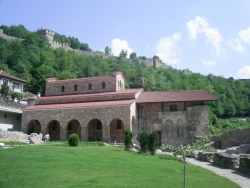
Veliko Tarnovo is one of the most ancient towns in Bulgaria. Its history spreads over more than five millenniums, as the first evidences of life found on Trapezitsa Hill are dated back to the third millennium B.C. The old part of Veliko Tarnovo – the tsar’s palace from the time when it has been the capital of Bulgaria during the Second Bulgarian Kingdom (1187 – 1393), is located on three hills — Tsarevets, Trapezitsa and Sveta Gora. According to contemporaries, during the Middle Ages Tarnovo has been the new Jerusalem, Rome and Constantinople, all in one [3].
In 1185 the brothers Assen and Peter announce in the Church of St. Dimiter the end of the Byzantium dominance, which has lasted 167 years and declare Tarnovo as the capital of the new Bulgarian Kingdom. The medieval town rapidly extends and develops into the most invincible Bulgarian fortress in the period 12-14 century. It turns into the most significant political, economic, cultural and religious center in Bulgaria.
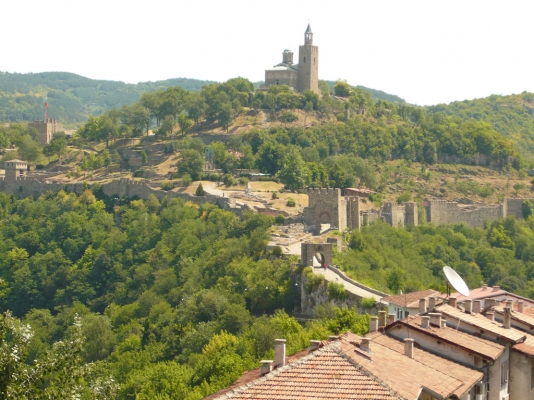
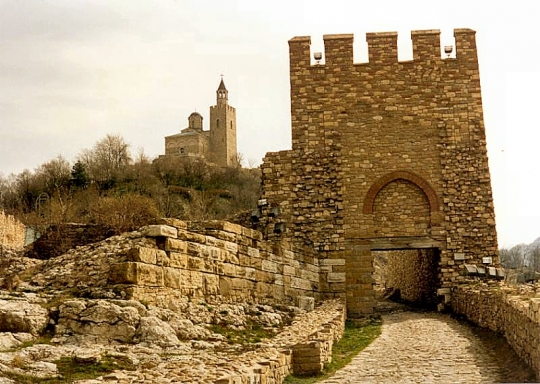
The hill Tsarevets is surrounded on three sides by the Yantra River. During the period of the Second Bulgarian Kingdom it is inhabited by the tsar’s entourage, the bolyars and the patriarch. It is belted by a castle wall built on naturally upright rocks. There used to be three entrances to the fortress. The main entrance has started in a drawbridge over the crossed rock and used to have three doors in a successive order, the second (the Small Gate) used to connect Tsarevets to Assenova Mahala and the third – to Frenchisar. Only one of the towers is preserved to date, nowadays called the Baldwin Tower. In the middle of Tsarevets there used to loom the palace, comprising a ceremonial hall, the church St. Petka, residential and stock buildings, water reservoirs and guard premises; it has been protected by solid stone walls and turrets.
On the highest point of Tsarevets there used to stand the patriarchal church “The Ascension of Christ”, with a four-angle bell-tower next to it and a residence building for the patriarch. The discovery of a large number of foundations of residential and other buildings across the whole terrain of the hill as well as in the palace itself and along the castle walls provides grounds to conclude that Tsarevets has not been an entirely closed fortress, but a genuine medieval town, densely built-up with residential and other buildings.
In 1598 the large-scale First Tarnovo Uprising starts and Shishman III is crowned as tsar. Only a few months later, the uprising is suppressed and many of its leaders perish or find a rescue to the north of the Danube River. In 1686 the town becomes the center of the Second Tarnovo Uprising lead by Rostislav Stratimirovich, but that uprising is crushed rather quickly, too.
After the Liberation and the execution of the Berlin Treaty the town becomes a temporary capital – the Constituent Assembly is convened here in 1879, which adopts the Tarnovo Constitution effective till the year 1947, the First Great National Assembly that has elected as knyaz Alexander I as well as a number of regular national assemblies.
* the trip is offered to individual tourists after placement of a preliminary order.