Rila Monastery
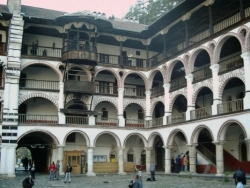
Nowadays the monastery is near the village of Pastra – not far form the place of its initial founding. The Rilska River flows nearby. This is the biggest monastery in Bulgaria — on 5 floors, as 4 of them are visible. This peculiarity of the building is explained with the restrictions imposed by the Ottoman authority in the year 1834 when the buildings we know today have been built. The museum is on the ground floor. In the Magernitsa (the cook house) the food for the monks used to be prepared.
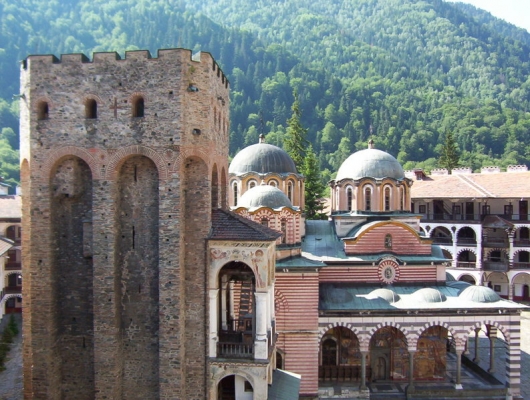
The Monastery St. John of Rila is built on the place of an Old Anchoress between 927-941 by John of Rila (or, according to some authors, by his disciples) in the Rila Mountain. In the yard of today’s monastery in the year 1335 a protection tower is erected as well as a small single nave church by the local feudal ruler protosevast Hrelyu. The tower is the oldest preserved building within the monastery complex and in terms of style belongs to the Tarnovo Art School.
Tsar Ivan Shishman (1371-1393) issues the Charter of Rila on 21st September 1378, signed and sealed with a golden seal by which to the monastery are provided as feudal possessions 20 villages along with their land territories.
Ever since its establishment the monastery becomes a scholarly and educational center. During the Bulgarian National Revival Neofit Rilski founds a monastery school there, as subsequently he develops a pedagogical activity on a large scale. The monastery provides shelter to Vassil Levski, Ilyo Voyvoda, Gotse Delchev, Peyo Yavorov, etc.
In 1778 St. John of Rila Monastery is devastated by a conflagration. It is restored in 1784 by Master Alexi who, during the period 1816-1819 designs and builds the eastern, northern and western section. A significant part of the monastery burns down again in 1833, as its restoration is again completed by Alexi under the guidance of the then Abbot, Yosiff the Builder.
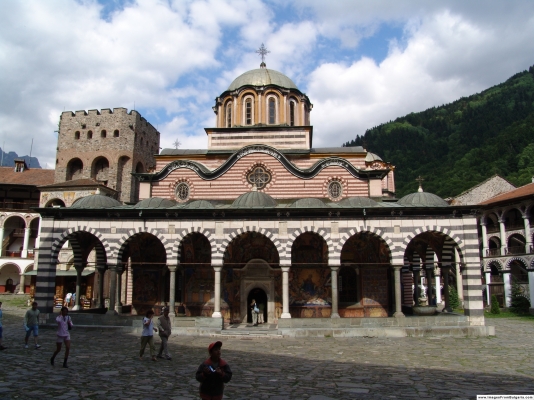
Nowadays the monastery’s complex covers a territory of 8800 square meters, out of which the built-up area is 5500 square meters. The monastery sections constructed in different periods on 4 and 5 floors surround the only yard from all sides forming the shape of an irregular pentagon.
* the trip is offered to individual tourists after placement of a preliminary order.